Having been a professional actor for over a month, I feel like I am now experienced enough to begin doling out advice on acting technique. This week, we shall start with a seemingly small but crucial step on your way to winning your Emmy for outstanding supporting actor or actress in a miniseries or TV movie (the highest of all honors). This step is, of course, memorizing your lines, which you would know if you read the title of this post. I made it pretty clear up there. It really says everything you need to know about this entry’s topic. Kind of makes this whole introduction irrelevant. If I had an editor, they might say, “What is this first paragraph? You don’t say anything here at all! Is it just for that weird Emmy joke? Is this going to be more garbled nonsense, like your last post? I can’t read another entry like that. Please, just cross this whole thing out. Also, who’s paying me? I’ve edited nine of these things, and I haven’t seen a dime. Do you have any sort of revenue stream at all? What’s going on here? Is this even a real— Hey, hey, put that down! What are you doing? NO, WAIT—”
Luckily for you, I don’t have an editor.
In my days and days of acting, I have seen several different line memorization techniques. Some actors keep their scripts in neatly organized binders and highlight all their lines and stage directions with a variety of colors. This color-coding helps them visualize their scenes and makes memorization significantly easier when the off-book date arrives. Other actors transcribe all of their scenes onto index cards, which both allows them to shed the cumbersome script during early rehearsals and creates an easy way for them to quiz themselves when the time comes for memorization. Other actors simply begin memorization as soon as possible, going off-book for certain scenes well before the official off-book date, giving them more freedom to explore the space and work on their physicality.
All of these approaches are wrong.
I present to you my Disintegrating Script Technique.™
First, do not keep your script in a binder or folder of any kind. Just stick some sort of heavy duty paper clip on the corner.
Make sure that you do not take any sort of special care of said script. Throw it around. Scribble all over it. Lose the back three pages. It should never look any better than this:
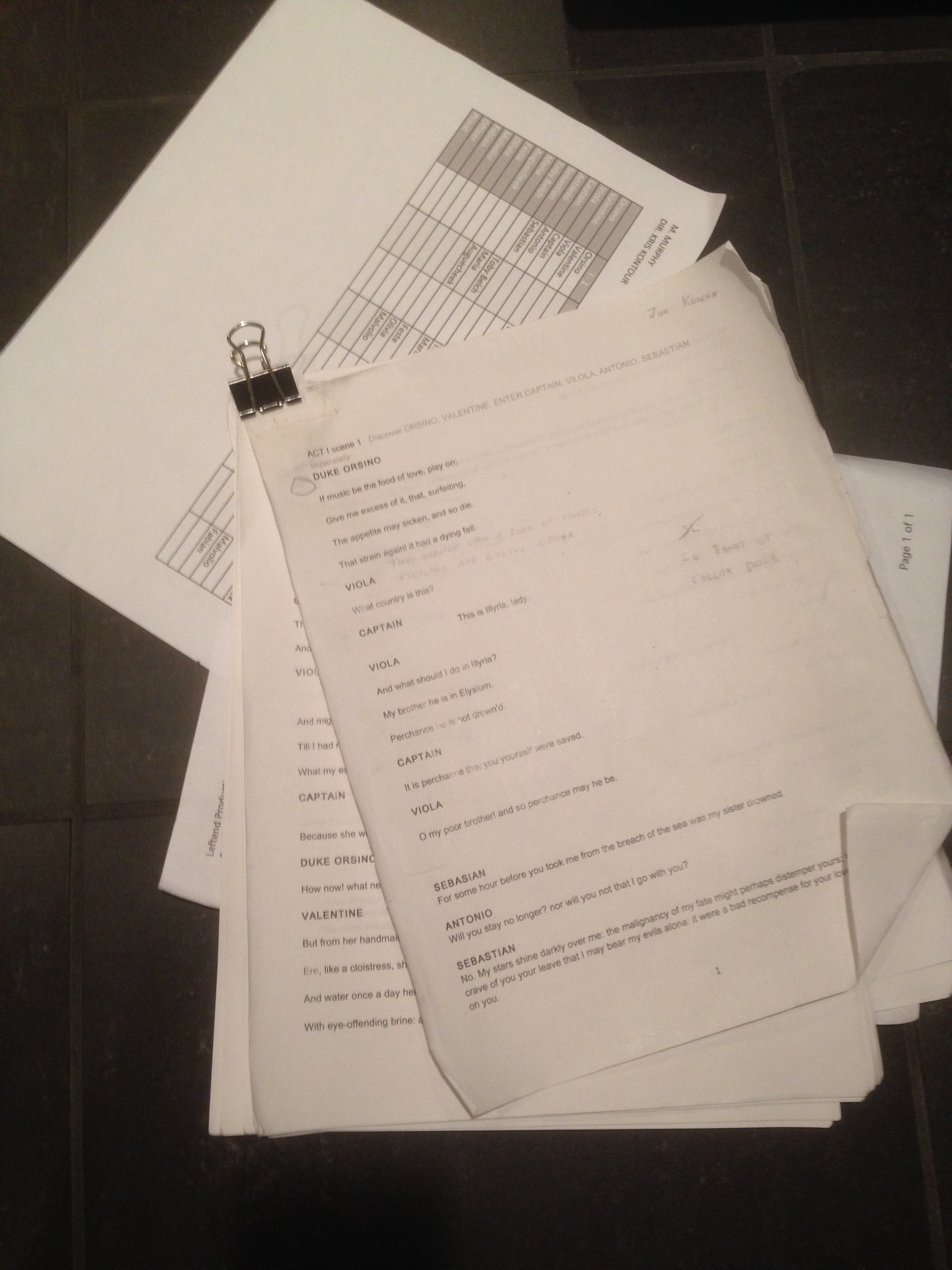
WordPress says, “Images are a vital part of grabbing a visitor’s attention, breaking up long pieces of content, and helping your content be shared across the web.”
Soon, your script will be nearly unusable. You will be embarrassed to show it at rehearsal. You will start to lose entire scenes. Your peers will judge you. Your superiors will shake their heads in disappointment.
You must memorize your lines before this happens.
The threat of shame is a powerful motivator. Depending on how much of a slob you are, you’ll probably learn your lines well before the off-book date.
It’s just that simple.
See you next week.
And if you are in Chicago and want to see me in a production of Twelfth Night (you do), buy your tickets here. I will be playing the role of Sir Andrew Aguecheek from October 10th-12th. If you cannot make it that weekend, I will be on stage the other nights as well, but in the smaller roles of the Captain, Officer, and Priest.
 How to Be an Actor in Chicago